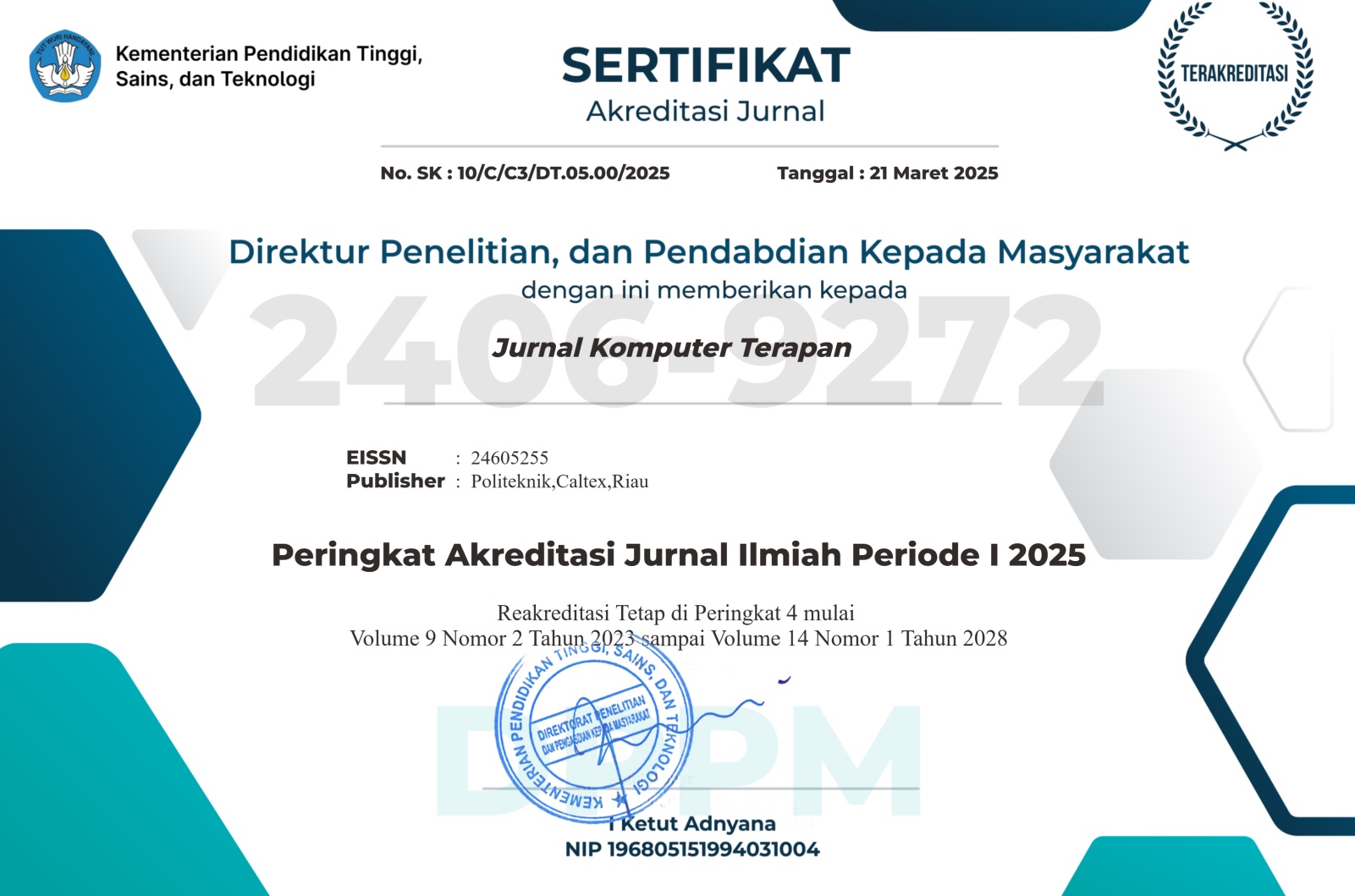
Application of Deep Learning on Types of Oil Palm Plant Diseases Using the Convolutional Neural Network Algorithm
DOI:
https://doi.org/10.35143/jkt.v8i2.5522Keywords:
Oil Palm, Deep Learning, Convolutional Neural NetworkAbstract
The problem of Plant Destruction Organisms (OPT), especially related to disease, has always been an issue in the management of oil palm plantations. Oil palm has diseases caused by pests and others that can affect the growth and fruiting process. For this reasearch, the aims to identify whether or not oil palm plants are healthy through the color of their leaves, so that it will facilitate the performance of farmers. Deep Learning (DL) is a field of science from machine learning by doing deeper learning for many layers. Convolutional Neural Network (CNN) is one of the DL algorithms designed to process data in two-dimensional form such as images. Therefore, in this study, the CNN method will be applied to classify the health of oil palm plants based on the color of the leaves. The data used are 3000 data with test scenarios for training data and testing data are 90%:10%, 80%:20%, 70%:30% and 65%:35%. Based on the 4 test scenarios, the best accuracy obtained is 99.90% for the scenario of 65% of training data and 35% of testing data. While the lowest level of accuracy is 99.50% for the scenario of 90% training data and 10% testing data.Downloads
References
S. Ilahiyah and A. Nilogiri, “Implementasi Deep Learning Pada Identifikasi Jenis Tumbuhan Berdasarkan Citra Daun Menggunakan Convolutional Neural Network,†JUSTINDO (Jurnal Sist. dan Teknol. Inf. Indones., vol. 3, no. 2, pp. 49–56, 2018.
S. F. Alamsyah, “Implementasi Deep Learning Untuk Klasifikasi Tanaman Toga Berdasarkan Ciri Daun Berbasis Android,†Ubiquitous Comput. its Appl. J., vol. 2, pp. 113–122, 2019, doi: 10.51804/ucaiaj.v2i2.113-122.
Al Rivan, M. E., & Riyadi, A. G. (2021). Perbandingan Arsitektur LeNet dan AlexNet Pada Metode Convolutional Neural Network Untuk Pengenalan American Sign Language. Jurnal Komputer Terapan , 7(1), 53–61. https://doi.org/10.35143/jkt.v7i1.4489
E. Rasywir, R. Sinaga, and Y. Pratama, “Analisis dan Implementasi Diagnosis Penyakit Sawit dengan Metode Convolutional Neural Network (CNN),†J. Paradig. UBSI, vol. 22, no. 2, pp. 117–123, 2020.
A. Asrianda, H. A. K. Aidilof, and Y. Pangestu, “Machine Learning for Detection of Palm Oil Leaf Disease Visually using Convolutional Neural Network Algorithm,†J. Informatics Telecommun. Eng., vol. 4, no. 2, pp. 286–293, 2021, doi: 10.31289/jite.v4i2.4185.
Widians, J.A., Rizkyani, F.A.â€Identifikasi Hama Kelapa Sawit menggunakan Metode Certainty Factor “ ILKOM Jurnal Ilmiah; Vol 12, No 1 (2020) doi: 10.33096/ilkom.v12i1.526.58-63:
Kusumaningrum, T.F., “Implementasi Convolution Neural Network (CNN) Untuk Klasifikasi Jamur Konsumsi Di Indonesia Menggunakan Keras,†vol. 151, no. 2, pp. 10–17, 2018 .
V. Maeda-Gutiérrez et al., “Comparison of convolutional neural network architectures for classification of tomato plant diseases,†Appl. Sci., vol. 10, no. 4, 2020, doi: 10.3390/app10041245.
Malika, Muna. Widodo,Edi.â€Implementasi Deep Learning Untuk Klasifikasi Gambar Menggunakan Convolutional Neural Network (Cnn) Pada Batik Sasamboâ€. Pattimura Proceeding Conference Of Science and Technology.2021.
S. Kulkarni and S. Harnoorkar, “Comparative Analysis of CNN Architectures,†vol. 7, no. June 6, pp. 1459–1464, 2020.
Downloads
Published
Issue
Section
License
Copyright (c) 2022 Jurnal Komputer TerapanÂ

This work is licensed under a Creative Commons Attribution-NonCommercial-ShareAlike 4.0 International License.
Copyright info for authors
1. Authors hold the copyright in any process, procedure, or article described in the work and grant the journal right of first publication with the work simultaneously licensed under a Creative Commons Attribution License that allows others to share the work with an acknowledgement of the work's authorship and initial publication in this journal.
2. Authors retain publishing rights to re-use all or portion of the work in different work but can not granting third-party requests for reprinting and republishing the work.
3. Authors are permitted and encouraged to post their work online (e.g., in institutional repositories or on their website) as it can lead to productive exchanges, as well as earlier and greater citation of published work.
This work is licensed under a Creative Commons Attribution-NonCommercial-ShareAlike 4.0 International License